
Artist Spotlight: Laura Watson & the White Fringeless Orchid
This piece is written by Laura Watson herself. We invite you to slow down, read closely, and experience this beautiful and rare orchid through her perspective as an artist.
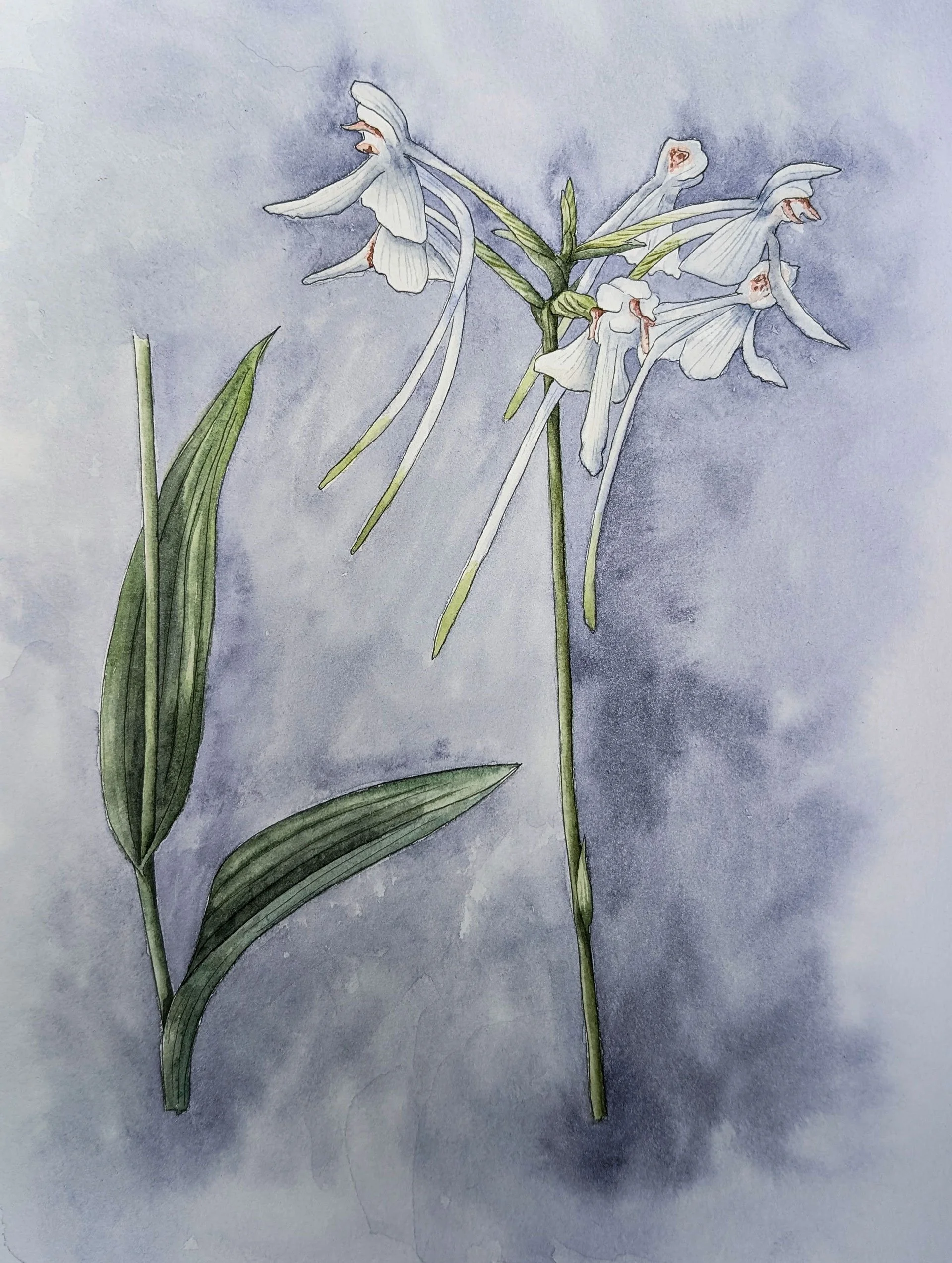
White Fringeless Orchid by Laura Watson
A Rare and Fragile Orchid
The White Fringeless Orchid (Platanthera integrilabia) is one of the rarest orchids in North America, found only in the wetlands and bogs of southeastern United States. Once common across Tennessee, Georgia, Alabama, and surrounding states, this delicate orchid has become federally threatened due to habitat loss, fire suppression, and wetland drainage.
Its smooth unfringed white lip distinguishes it from its relatives in the genus Platanthera, many of which have ornate fringes. Blooming from late July through September, its pale flowers are adapted to stand out in dim light, and they release a sweet fragrance in the evening to attract pollinators such as butterflies and possibly moths.
One of the most remarkable things about this orchid is its reliance on a very specific soil fungus to germinate. This means that simply transplanting seeds will not reestablish the species; the entire wetland ecosystem must be restored for the orchid to survive. Because of this, it has become a powerful symbol of how fragile and interconnected natural systems truly are.
Imagining the Encounter
Although this orchid does not grow here in British Columbia, I had the privilege of illustrating it for this feature. As I worked, I imagined walking through a southern wetland in late summer, where dragonflies hover above mossy ground and the air is heavy with humidity. Amid the sedges, the orchid’s white flowers would rise like quiet sentinels, a fragile yet steadfast presence in a vulnerable habitat.
About Laura Watson
I am a botanical artist and instructor based on Vancouver Island, Canada. My lifelong love of plants began in childhood and continues to inspired my detailed watercolour botanical portraits and teaching practice. I have a Diploma with Distinction in Botanical Painting from the London Art College and a diploma with credit from the society of Botanical Artists (SBA) in the UK. In 2015, I was accepted into the Botanical Artists of Canada (BAC). I have had the privilege of participating in rare plant surveys alongside scientists and published authors here in British Columbia. My work blends scientific accuracy with artistic storytelling. I use watercolour and ink to capture both the beauty and fragility of native plants. I teach online through The Watercolour Garden, an online learning community where I share full length painting classes, challenges, and resources for artists who want to connect more deeply with plants through art. I am also currently completing a Bachelor of Science degree in Environmental Practices to become a Professional Agrologist. This path allows me to bridge my artistic work with applied environmental science and stewardship.
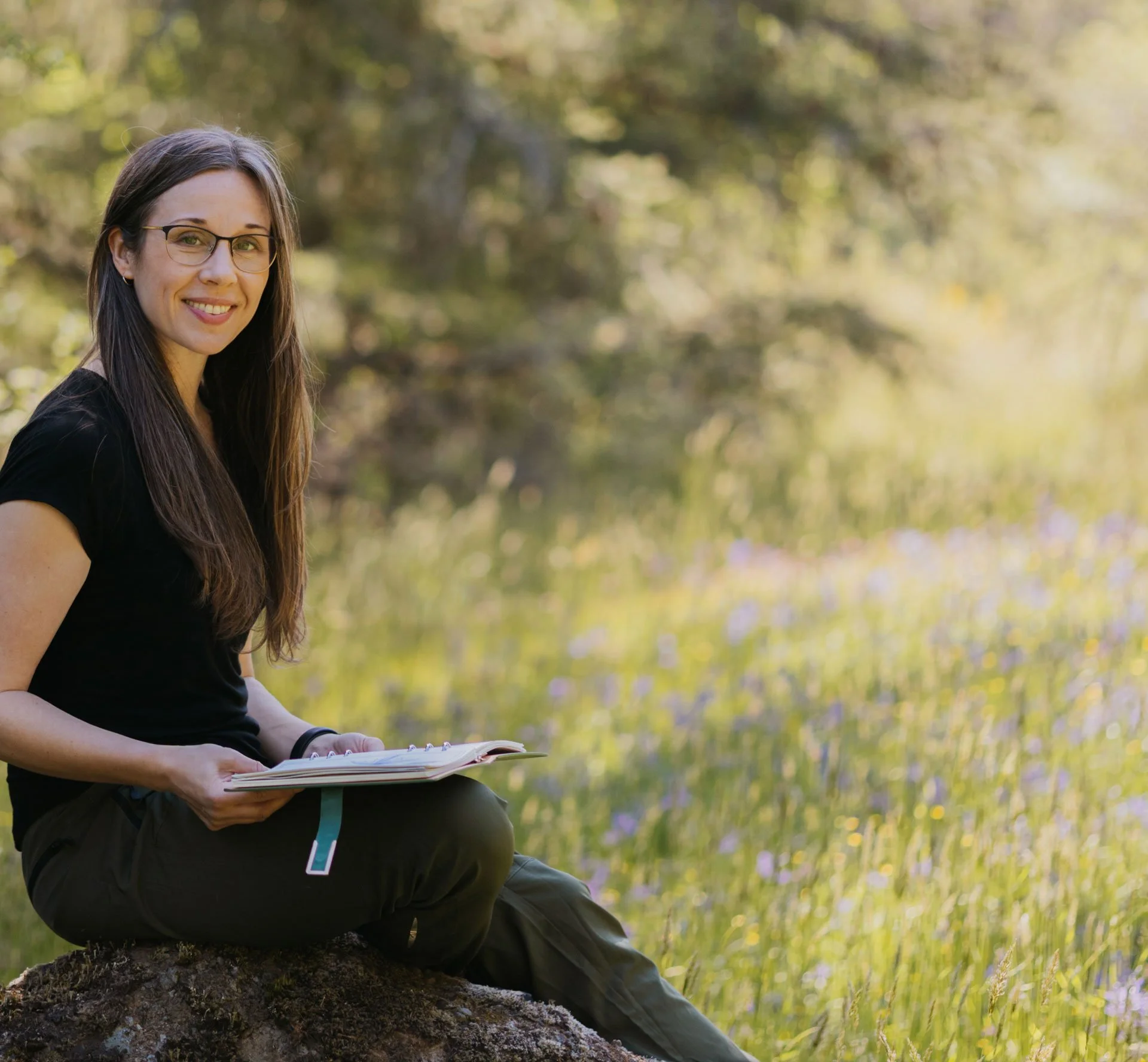
Laura Watson
To continue the conversation, we asked Laura a few questions about her artistic practice, her connection to nature, and the ideas that inform her work.
An interview with Laura Watson follows:
How did you get started in art?
I began drawing plants as a teenager, inspired by time spent outdoors — my curiosity about how things grow turned into a practice of observing closely and sketching. Over time, that practice evolved into formal training in botanical illustration and eventually into teaching others.
What inspires you most about nature?
I’m inspired by the way every plant tells a story of resilience, adaptation, and connection. Native plants, especially, carry the character of their ecosystem — they show us how life fits together like a puzzle.
Do you have a favorite place or species you love to draw from?
Here on Vancouver Island, I’m endlessly inspired by the Pacific Northwest wildflowers — from delicate calypso orchids in the forest to bold tiger lilies in the meadows. Each season brings something new to discover.
How do you hope your art connects people to the natural world?
My hope is that my work helps people slow down, notice the details, and build a personal connection with plants. Whether it’s through a class, a blog, article or a painting, I want viewers to feel wonder and respect for the ecosystems around them.
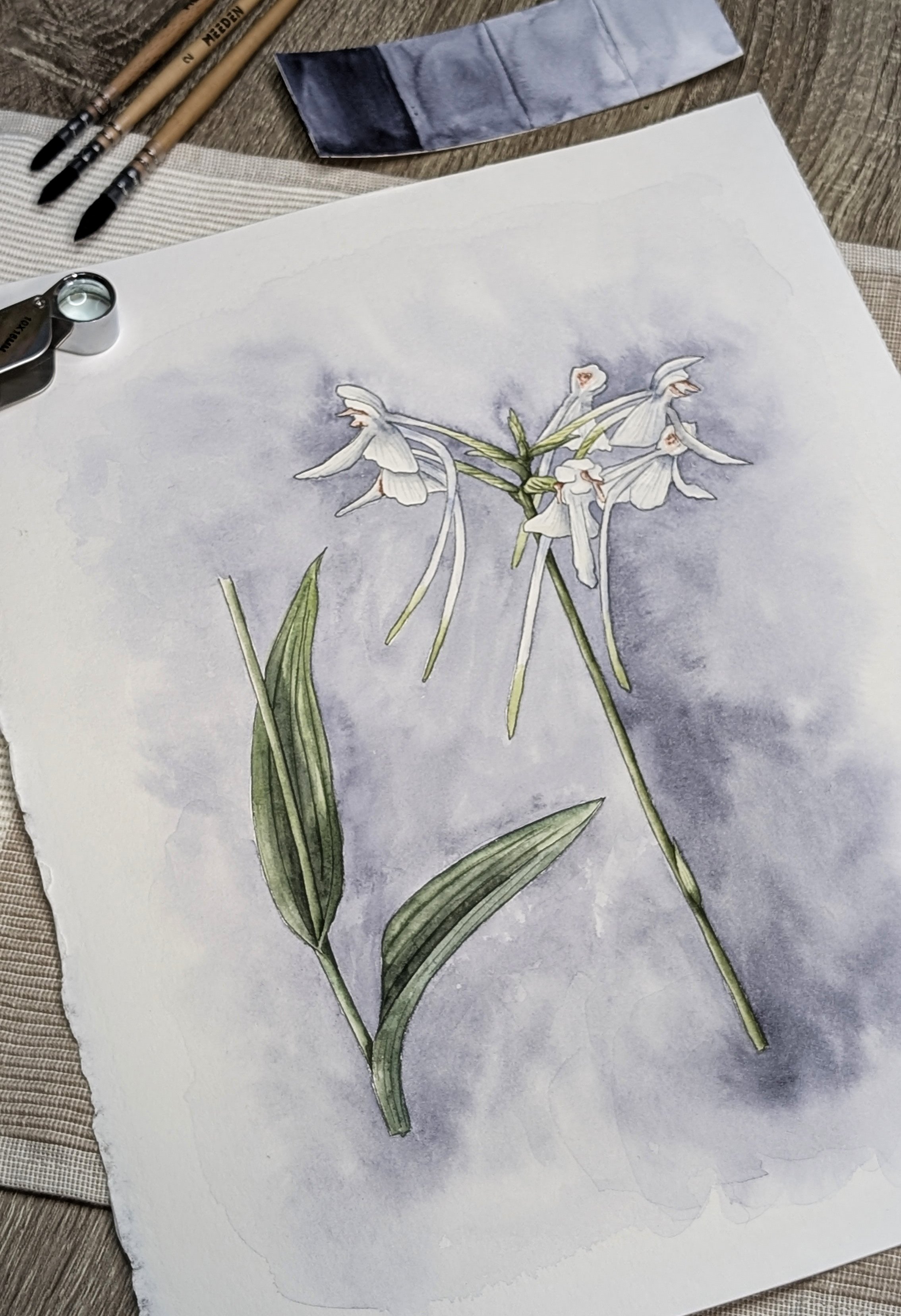
Closing Thoughts
The White Fringeless Orchid is more than just a rare species, it’s a reminder of how entire ecosystems depend on balance. Its survival hinges on wetlands being protected and restored, not just for the orchid itself but for the countless other species that share its home.
Through illustration and storytelling, we can honor plants like this one and highlight their importance far beyond the places they grow.
Sources
● U.S. Forest Service – Plant of the Week: Platanthera integrilabia
● Center for Biological Diversity – Fringeless White Orchid: Natural History
● North American Orchid Conservation Center – Go Orchids: Platanthera integrilabia